

A message from the bank. A news alert. A social media notification. One conversation interrupted by another, while yet another thread of communication unfolds in parallel. This is what everyday life looks like, and it is also how Bára Gísladóttir’s opera Good Vibes Only takes shape: as a continuous flow of information that, taken together, paints a picture of the world we live in.
Commissioned by Deutsche Oper Berlin, the opera is scored for eight singers, a full orchestra, an 80-voice choir, five instrumental soloists and electronics. Working with such a vast musical ensemble, Gísladóttir creates an intense and ever-shifting sound world in which different sonic landscapes emerge, overlap and disappear.
Written by Joris Lacoste, the libretto is not a conventional narrative that unfolds from beginning to end. Instead, it offers snapshots of human communication, both in our personal lives and through social media. Fragments of human relationships including a couple’s conflicts, hints of infidelity and complicated family dynamics - bring the opera back and forth between the rapid-fire information streams of everyday life and more intimate glimpses into people’s lives.
“The work moves between expositions, where everything happens very quickly, and episodes where we can delve deeper into the music and a particular theme,” Gísladóttir explains.
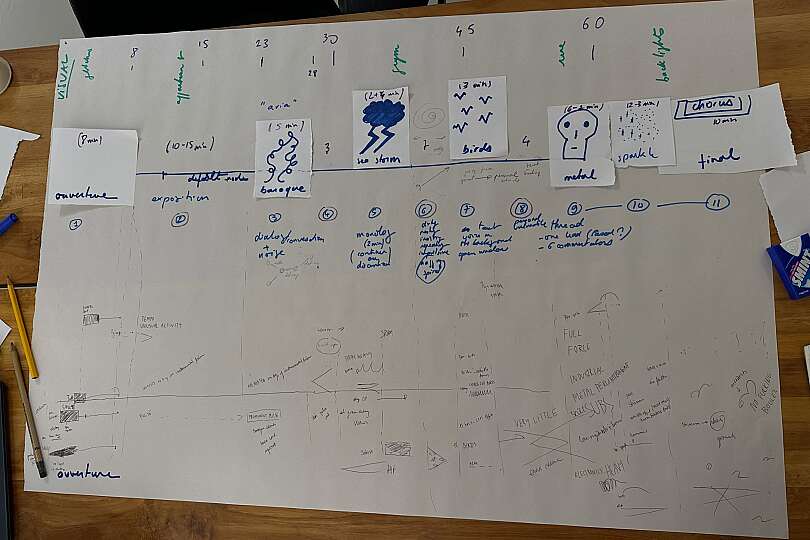
These fast-paced expositions act as breaks in the work, brief interludes between the more extended episodes. Here, the music can branch off in a new direction, opening up entirely different worlds for the listener in sections with titles such as Baroque, Sea Storm, Heartbreak, Metal and Sparkle, before the relentless flow of information takes over once again.
Gísladóttir is fascinated by the movement in and out of these miniature worlds, each with its own structures and textures. In some passages, the music is massive and insistent; in others, it is focused or meditative.
The Baroque as Avant-Garde
Although Gísladóttir does not consider herself a particularly devoted opera fan, she has a special fondness for Baroque opera. ”I have been obsessed with Vivaldi for years now, and my favourite opera is his Orlando furioso,” she tells, and the musical world of the Baroque has played a central role in the creation of Good Vibes Only.
She describes one part of the opera as entering into a kind of conversation with Vivaldi. Drawing on the harmonies and compositional techniques of Baroque music, she does not simply imitate a historical style. Instead, she seeks to expand it, bringing it into dialogue with her own sonic universe.
“I wanted to use a harmonic language I wouldn’t normally turn to and then expand it through various extended playing techniques. We have the Baroque basso continuo, but the sound spreads in every direction, with outbursts happening all the time, becoming very vivid.”
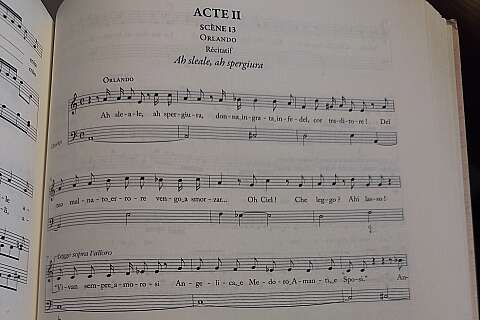
For Gísladóttir, the Baroque is not just a closed chapter in music history – quite the opposite. “The Baroque is avant-garde. It was so far ahead of its time, and it still is. You can find a kind of drone music in the Baroque, for example, where the harpsichord repeats the same figure over and over. That comes close to some of the music we make today – drone, metal, electronic music and rave.”
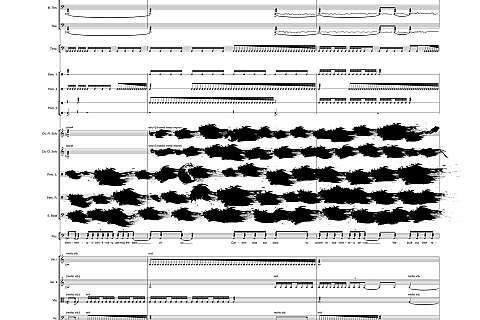
She also sees connections between the Baroque and the present on a broader cultural level, extending beyond music to ideals and patterns of behaviour. For her, bringing Baroque and contemporary music together makes perfect sense on every level.
In Good Vibes Only, this encounter allows her to explore musical references in a way she might otherwise hesitate to embrace.
“I sometimes find music that incorporates quotations a little sterile and inaccessible. But here, it makes complete sense, particularly in the context of a staged production. If I had written a work that wasn’t intended for the stage, I probably wouldn’t have quoted Baroque music in this way.”
It is precisely the theatrical setting and the operatic format that give her this particular freedom. While the format imposes certain limitations, it also opens up possibilities she might not otherwise have allowed herself in a purely instrumental work.
A diverse cast of singers
Composing for a libretto meant that Gísladóttir’s work process has been different from the usual. She normally follows a more intuitive process, allowing the music to evolve without defining all the structural parameters of a piece in advance.
“Having the libretto as a starting point gave me an anchor. At the same time, I was very conscious of not letting the text become the only driving force. Sometimes you hear operas with so many words that you feel the music could have told much of the story without spelling everything out.”
Gísladóttir often manipulates instruments and explores their mechanical possibilities, but the human voice presents a different set of limitations.
“In a way, working with something as natural and organic as the voice can be a little restrictive, because you don’t have the same mechanical possibilities as you do with instruments. You can’t manipulate the voice in the same way without causing pain or risking injury,” she says.
Instead, she has taken the eight singers’ individual experience and abilities as her starting point. The cast is exceptionally diverse in terms of vocal technique. Some singers have experience in contemporary music and heavy metal; others can perform throat singing, multiphonics and a range of extended vocal techniques. Still others are highly specialised in the traditional classical operatic repertoire or possess extraordinary vocal range and control.
For the most part, Gísladóttir has treated the eight voices as one varied, collective ensemble rather than as eight individual protagonists.
“The voices move through the music like little streams, crossing one another and merging into a single, large vocal machine. But there are also passages with more traditional solo singing and actual melodies,” she explains. “That has been a huge challenge for me, because, as many probably know, I don’t usually write melodies.”
Outside the comfort zone
Just as Gísladóttir challenges herself, she also pushes the boundaries for the musicians and singers she works with. Although the work has been tailored to the performers, she has not restricted herself to what she already knows they can do. She sets high expectations for musicians and is interested in discovering what happens when she asks them to play or sing something she knows is extremely challenging.
“This is definitely not a work that stays within the comfort zone,” she says. “But I believe musicians generally want to challenge themselves. You don’t need to convince them to do that.”
Alongside the singers, she has selected five instrumental soloists who play a special role in the work. Familiar with their musical capabilities, she sees them as a bridge between the orchestra and the singers. “For me, they have been an enormous source of reassurance throughout the compositional process, because I know exactly what these people are capable of. For them, the sky is the limit.”
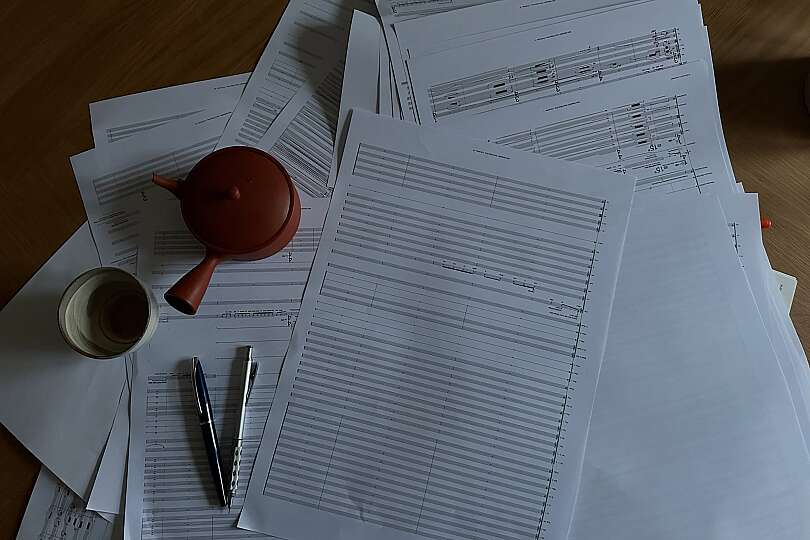
Not everyone’s cup of tea
The Baroque is not the only musical influence in Good Vibes Only. Gísladóttir’s love of heavy metal has also left its mark. She is deeply drawn to the genre and occasionally takes inspiration from it, but in her own music she adds the deep bass she feels is missing from much of metal.
Gísladóttir’s music is often described as dark and even violent, and she finds that it is sometimes interpreted as an expression of anger. She does not recognise her own musical universe in these descriptions. “On the contrary, I experience it as an incredible source of energy, joy and freedom to be able to burst out without any restrictions.”
For Gísladóttir, music should not merely be heard; it should be felt physically. “We are always looking for meaning in everything. But when you can really feel the music, when you can physically feel the sound waves, you feel that you are alive. That makes so much sense to me,” she says.
She does not expect Good Vibes Only to be everyone’s cup of tea. “That is very unlikely,” she says with a smile. The way people experience the music, she explains, naturally depends on what they bring with them into the opera house, what they are used to listening to and how open they are to new experiences - including when it comes to noise.
“I think that if you, as a listener, experience something as very loud, that often says at least as much about you as a person as it does about the music itself. But the work isn’t intended to make anyone feel uncomfortable. It’s Good Vibes Only.”
Good Vibes Only is premiered at the Deutsche Oper Berlin 22 January 2027 with additional performances 27.1.27, 31.1.27, 2.2.27 and 12.2.27.
The production is made possible with the generous support of the Ernst von Siemens Music Foundation.
Find more information about Good Vibes Only at Deutsche Oper Berlin