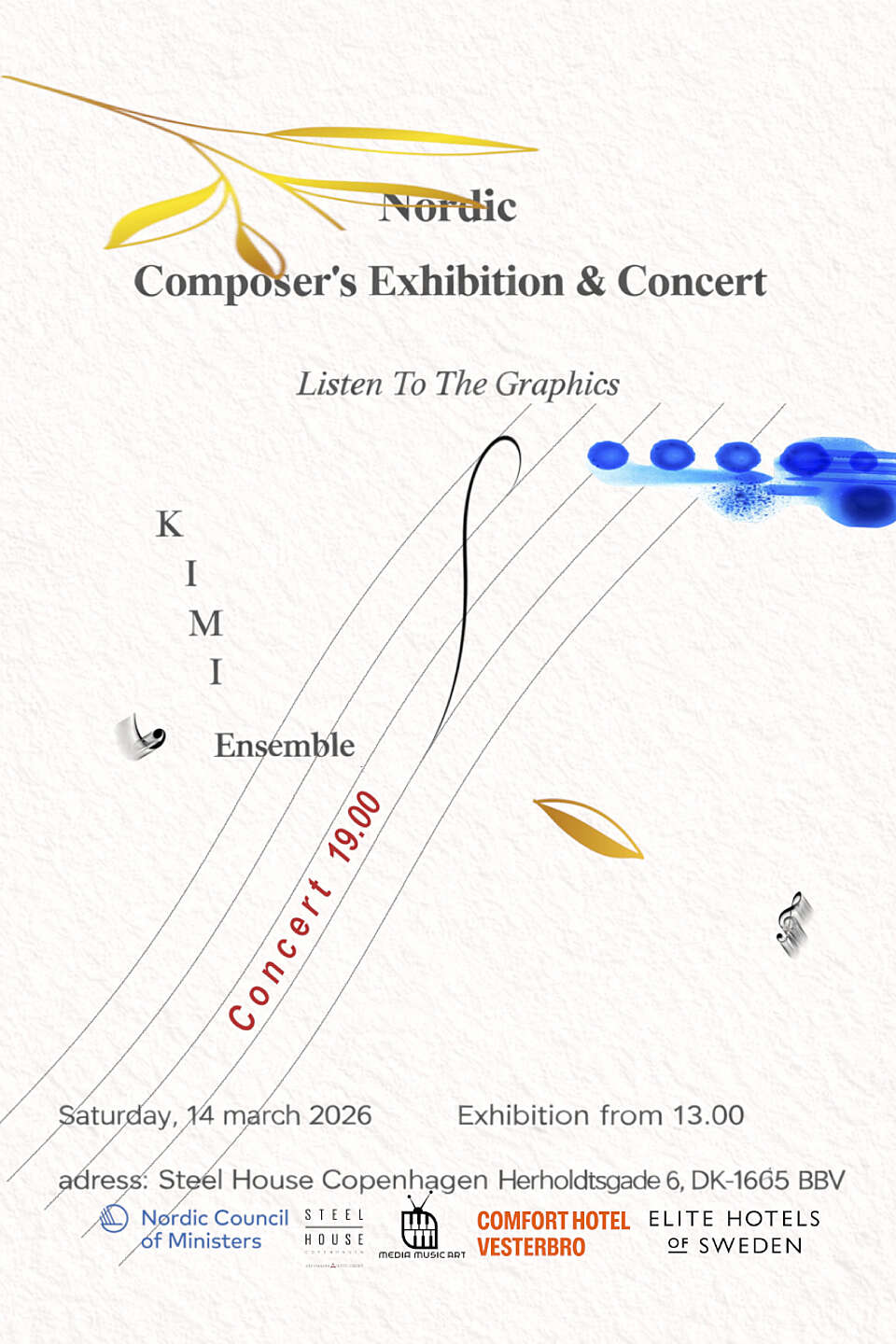
From 13.00, visitors can experience an exhibition of graphic scores, drawings and selected paintings created for the occasion. At 19.00, the day continues with a concert featuring Kimi Ensemble.
The project brings together around 25 Nordic composers and explores a question that has fascinated Hosseini for years: What happens when music is no longer written in notes and staves, but in lines, shapes, colours and textures?
From Research to Exhibition
The idea for the exhibition grew out of Hosseini’s own artistic curiosity. While preparing to compose a new work, he began studying works by other composers.
“I did research to do a graphic score myself,” he explains. “And then I got really fascinated… a lot of them are very beautiful. They look like photography, like paintings. Some of them didn’t even have anything resembling traditional notation.”
As he delved deeper, he found himself reflecting not only on their visual qualities but also on their musical intentions. Were these drawings spontaneous gestures, or carefully constructed musical structures?
“If you want to go really into detail, composers don’t just draw random lines,” he says. “ “It’s to give it a certain feelin, a story or to add improvisation and freedom to the music.”
The visual power of the works convinced him that they deserved to be experienced in a gallery setting. Although not a visual artist himself, Hosseini has long collaborated with painters and photographers. “I’ve worked a lot with visual artists,” he says. “So I got the idea: what if I did an exhibition inviting other composers and shared the concept with an audience?
Rather than looking overseas, he chose to focus on neighbouring Nordic countries. He reached out to composers and publishers in Denmark, Norway, Sweden, Finland, Iceland and the Faroe Islands. The response was overwhelmingly positive, and each participating composer is represented in the exhibition with one page or excerpt from a graphic score—offering a glimpse into their visual-musical world.
A Diverse Nordic Landscape
The exhibition presents an impressively diverse group of composers—across generations, nationalities and artistic approaches. Among the participants are:
- Ruth Wilhelmine Meyer (NO)
- Irene Becker (DK)
- Carl Bergstrøm-Nielsen (DK)
- Jørgen Plaetner (DK)
- Else Marie Pade (DK)
- Henning Christiansen (DK)
- Jan Maegaard (DK)
- Rosali Grankull (SE)
- Unn Patursson (Faroe Islands)
- Lív í Baianstovu (Faroe Islands)
- Khabat Abas (SE)
- Lilja María Ásmundsdóttir (IS)
- Mansoor Hosseini (SE)
- Eric Egan (NO)
- Ella Eriksson (SE)
- Henrik Rasmussen (DK)
- Henrik Colding-Jørgensen (DK)
- Herman Rechberger
The time span stretches from historical figures who have passed away to emerging composers who have only recently graduated. This breadth allows visitors to trace aesthetic differences across decades. Hosseini notes that he can often sense the era of a work immediately.
Older works often appear intuitive and minimal. “Sometimes it looks like a child has painted something—and I mean it in a positive way,” he says. “It looks more simple. It’s at times less material on the page.”
By contrast, many newer graphic scores are denser and more information-heavy. “Now if you get a young person to do a graphic score, it’s loaded with information. A lot of lines, more clean shapes. It looks like it’s drawn with tools.”
For Hosseini, this is not necessarily a linear development, but a visible shift in visual language—reflecting broader changes in artistic tools and aesthetics.
From Image to Sound
At 19.00, the focus shifts from wall to stage. Kimi Ensemble will perform selected works from the exhibition. The ensemble specialises in contemporary music and has prior experience with graphic scores.
Graphic scores inherently invite interpretation. “I’m sure it would be very, very different each time someone plays it,” Hosseini reflects. “Even if the same person plays it.” Some scores offer clear visual cues like dots rising and falling across the page, while others consist of abstract constellations of lines and shapes. One score even takes the shape of a knitted sweater.
Hosseini also presents a new piece of his own created especially for the event, developed in collaboration with the painter Maria-Louisa Pfeifer. Significantly, he chose not to draw the score himself. “One thing was very clear for me from the beginning,” he says. “I didn’t want to do the drawing myself. I wanted to work with an artist.” The piece is based on a poetic image: a woman lying in a forest, her long hair spreading out across the ground. “And these hair lines are my graphic score,” he explains.
Seeing Music Differently
Ultimately, Hosseini hopes the audience will approach the exhibition with open senses. “I’m hoping that people see it, at the first instinct, like an artwork” Only afterwards should the question arise: “How can this be music?”
By inviting viewers to take these two steps - first aesthetic appreciation, then musical reflection - he aims to expand perceptions of what a score can be. “I just want the audience to see music scores in a different way,” he concludes.